Electronics lab report template in LaTeX
An electronics lab needs characteristics and measurement tables - this template has them ready. Add your results, attach the circuit diagram and compile to PDF in a minute.
- Space for the measurement circuit diagram
- Current-voltage characteristic tables
- Results analysis and conclusions section
- amsmath included in the preamble
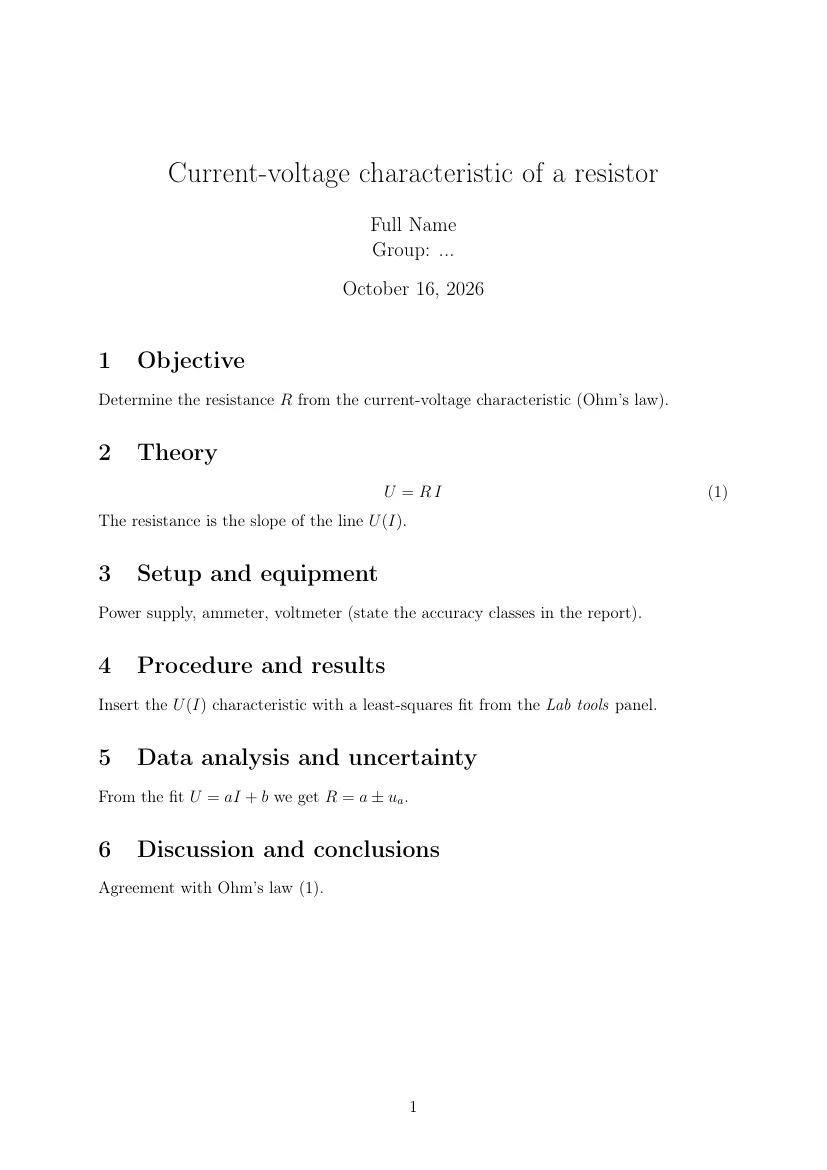
Template code
% --- CamteX: Electronics lab report ---
\documentclass[a4paper,12pt]{article}
\usepackage[utf8]{inputenc}
\usepackage[T1]{fontenc}
\usepackage[english]{babel}
\usepackage{amsmath}
\usepackage{amssymb}
\usepackage{siunitx}
\sisetup{separate-uncertainty=true}
\usepackage{graphicx}
\usepackage{xcolor}
\usepackage{float}
\usepackage{caption}
\usepackage{booktabs}
\usepackage{pgfplots}
\pgfplotsset{compat=1.18}
\usepackage[hidelinks]{hyperref}
\usepackage[margin=2.5cm]{geometry}
\title{Current-voltage characteristic of a resistor}
\author{Full Name \\ Group: ...}
\date{\today}

\begin{document}
\maketitle

\section{Objective}
Determine the resistance $R$ from the current-voltage characteristic (Ohm's law).

\section{Theory}
\begin{equation}\label{eq:ohm}
  U = R\,I
\end{equation}
The resistance is the slope of the line $U(I)$.

\section{Setup and equipment}
Power supply, ammeter, voltmeter (state the accuracy classes in the report).

\section{Procedure and results}
Insert the $U(I)$ characteristic with a least-squares fit from the \emph{Lab tools} panel.
% The plot from the panel has the label fig:reg, so in the text: Figure~\ref{fig:reg}.

\section{Data analysis and uncertainty}
From the fit $U = aI + b$ we get $R = a \pm u_a$.

\section{Discussion and conclusions}
Agreement with Ohm's law~\eqref{eq:ohm}.

\end{document}
Don't type math by hand.
Snap a photo of your handwritten notes or draw a formula, and CamteX AI turns it into LaTeX and inserts it into your document. 3 scans without an account, then 10 every month on the free plan.
How to use this template?
- "Open in CamteX" loads the template into the editor in your browser, and "Open in Overleaf" creates a new project with it.
- You can also copy the code and paste it into your own document.
- Fill in your details and content: the structure and preamble are ready.
- Compile to PDF.
Frequently asked questions
- Which packages does this template use?
- inputenc (UTF-8 encoding of the source file), fontenc (T1 fonts, so accented characters copy and hyphenate correctly), babel (document language: section names, the date and hyphenation), amsmath (multi-line equations, \dfrac and matrices), amssymb (extra math symbols), siunitx (numbers and SI units via \num and \SI), graphicx (images via \includegraphics), xcolor (text colors), float (a table or figure exactly in place with [H]), caption (the style of table and figure captions), booktabs (clean table rules), pgfplots (plots from measurement data), hyperref (clickable references in the PDF), geometry (page margins). All of them ship with TeX Live and Overleaf, so there is nothing to install.
- How do I compile this template?
- With pdfLaTeX, the default on Overleaf and in TeX Live. The document uses the article class (A4 paper, 12 pt font), and the babel package sets the language to English.
- Can I edit the template without installing LaTeX?
- Yes. "Open in CamteX" loads the template into the editor in your browser, and a TeX Live server builds the PDF (with a free account). "Open in Overleaf" creates a new Overleaf project with this code.